🚀 Key Takeaways
- •Explosive Growth: The civilian market CAGR exceeds 300%, with a market explosion of tens of billions expected in 2025.
- •Core Drivers: Standardization of L2+ autonomous driving, privacy monitoring in smart homes, and cost advantages of the local supply chain.
- •Technological Leap: 4D imaging radar solves height recognition pain points, and CMOS processes help reduce unit prices to the hundred-yuan level.
- •All-weather Advantage: Compared to cameras and LiDAR, mmWave possesses superior penetration through rain and fog and high privacy protection attributes.
Introduction: Latest industry reports show that the millimeter-wave (mmWave) radar civilian market is surging at a compound annual growth rate (CAGR) of over 300%, with the market scale expected to reach new historical heights in 2025. What are the forces driving this staggering growth? From once-unreachable military "mysterious zones" to now flourishing in smart vehicles, smart homes, and industrial automation, the wave of mmWave radar civilianization is reshaping our technological landscape. This article will deeply analyze the three core forces driving this transformation and look forward to its future market structure.
💡 User Benefits Behind Technical Specifications
Market Status: The Leap from "Military Exclusive" to "Civilian Explosion"
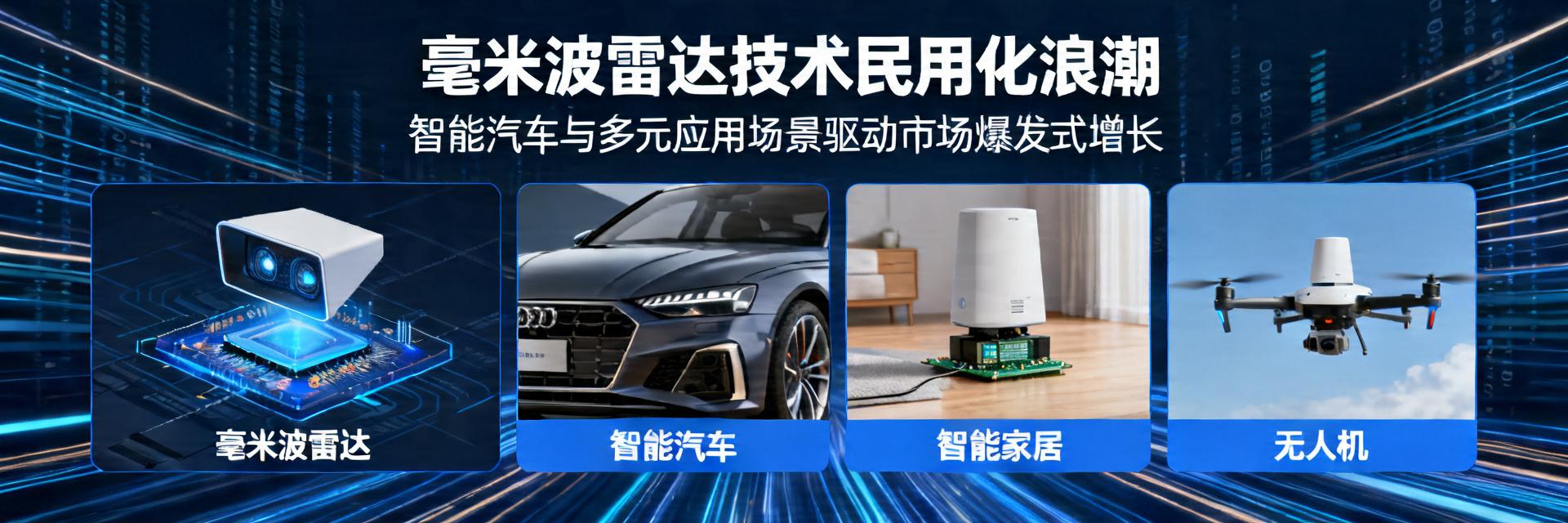
Millimeter-wave radar technology is undergoing a profound identity shift. Previously, it was mainly used in high-end fields such as national defense and meteorology, with high technical barriers and expensive costs. Now, with advances in semiconductor processes and the maturity of the industry chain, its cost has dropped significantly while performance has improved markedly, paving the way for large-scale civilianization. The market is rapidly opening its doors from a closed professional field to the vast consumer and industrial markets.
Comparison of Mainstream Sensing Technologies
| Comparison Dimension | mmWave Radar | LiDAR | Camera (Vision) |
|---|---|---|---|
| Environmental Adaptability | Excellent (Penetrates rain, fog, and snow) | Average (Affected by heavy fog) | Poor (Highly affected by lighting) |
| Velocity Capability | Native high-precision Doppler velocity measurement | Calculated via frame difference | Estimated via algorithms |
| Cost Advantage | High (Entered the 100-yuan era) | Low (Thousands to tens of thousands of yuan) | Very High |
| Privacy Protection | Captures only point clouds (No privacy risks) | Clear outlines | High risk (Image acquisition) |
Data Speaks: Panoramic Scan of Market Size and Growth Rate
According to research data from several authoritative organizations, the current mmWave radar civilian market is in the early stages of explosive growth. By 2025, the global market scale is expected to reach the billion-dollar level, with the Chinese market becoming one of the fastest-growing engines. The CAGR of over 300% clearly outlines a nearly vertical growth curve, driven by the concentrated release of demand in multiple downstream application areas.
Technological Breakthrough: Dual Catalysis of Falling Costs and Rising Performance
The core of the market leap is the breakthrough in technology itself. On one hand, the integration of RF chips based on advanced processes like CMOS continues to improve, making mmWave radar front-end modules smaller, lower in power consumption, and more cost-competitive. On the other hand, progress in algorithms and signal processing has led to a qualitative leap in radar detection accuracy, resolution, and anti-interference capability. The "scissors gap" effect between cost and performance is the key igniter for the market explosion.
Driver 1: The "Strongest Engine" of the Smart Vehicle Wave
Undoubtedly, the smart vehicle is the strongest driver for the current civilianization of mmWave radar. As autonomous driving levels advance toward L2+ and above, the demand for environmental perception around the vehicle is growing exponentially. With its unique advantages such as all-weather operation, precise velocity and distance measurement, and immunity to lighting and harsh weather, mmWave radar has become an indispensable sensor in Advanced Driver Assistance Systems (ADAS).
Engineer Field Test Review: Jiacheng Zhang (Senior RF Systems Engineer)
12 years of experience in RF and radar system R&D
"In actual PCB layout, mmWave radar performance often depends on antenna feedline integrity. We recommend strictly controlling trace impedance during design and using low-loss laminates (such as the Rogers series). Regarding 'noise interference' common in the civilian market, it is suggested to focus on phase noise specifications during selection and reasonably place decoupling capacitors (10pF/100nF in parallel) to filter out high-frequency power ripples. Additionally, thermal design is easily overlooked after civilian cost reduction; compact packages must ensure the bottom Thermal Pad is fully soldered to the ground layer."
Standard for L2+ Autonomous Driving, Explosive Demand for Automotive mmWave Radar
From Adaptive Cruise Control (ACC) to Autonomous Emergency Braking (AEB), and from Blind Spot Detection (BSD) to Cross-Traffic Alert (CTA), mmWave radars are now found in every corner of modern smart vehicles. Industry trends indicate that L2 and above models are evolving from 1-3 forward-looking radars to "5R" configurations with 4-5 corner radars, significantly increasing the number of radars per vehicle and directly driving the surge in market demand.
Driver 2: "Full Bloom" of Diverse Application Scenarios
Beyond the main battlefield of smart vehicles, mmWave radar technology is rapidly penetrating various emerging fields such as smart homes and the Industrial Internet of Things (IIoT) due to its non-contact and privacy-protecting characteristics, forming a multi-point driven market structure.
Smart Home Care
Enables fall detection and sleep breath monitoring without video privacy concerns.
Hand-drawn illustration, non-precise schematic
AGV/Industrial Obstacle Avoidance
Provides centimeter-level collision avoidance perception in dusty and low-light environments.
Hand-drawn illustration, non-precise schematic
Driver 3: "Collaborative Boost" from Policies and the Industry Chain
The vigorous development of the market is inseparable from top-level design and industry ecosystem support. The guidance of national strategies, the establishment of industry standards, and the rise of the local supply chain together constitute the third major driver for mmWave radar civilianization.
Future Outlook and Challenges: The Next Stop for Civilian mmWave Radar
Standing at the starting point of high-speed growth, the path of mmWave radar civilianization is full of both opportunities and challenges. Continuous technological integration and breakthroughs will be key to determining its future market boundaries.
🛠 Selection Pitfall Guide
- Voltage Margin: It is recommended to reserve a 20% margin for input voltage to prevent peak current fluctuations during startup.
- Thermal Considerations: High-power imaging radars must have large areas of ground copper on the bottom layer to assist in heat dissipation.
- Blind Zone Identification: Pay attention to the gain drop-off at the edges of the Antenna Field of View (FoV), and increase overlapping coverage if necessary.
Key Summary
- Explosive Market Growth: The mmWave radar civilian market is expanding rapidly at a CAGR of over 300%. The market size is expected to hit a new high in 2025, with smart vehicles being the primary growth engine.
- Three Core Drivers: Growth is driven by the rigid demand for smart vehicles, the implementation of diverse scenarios like smart homes/IIoT, and national policy guidance combined with local industry chain collaboration.
- Continuous Tech Iteration: From traditional radar to 4D imaging radar, technological progress is improving performance while lowering costs, forming the basis for market popularization. Deep integration with cameras and LiDAR is the future.
- Opportunities and Challenges: While market prospects are broad, challenges remain in further technological breakthroughs, intense market competition, and increasingly important privacy security and regulatory compliance.
FAQ
Q1: What is the main reason for the sudden explosion of mmWave radar in the civilian market?
There are three main reasons: First, the popularity of smart vehicles, especially L2+ autonomous driving, has created an explosive demand for reliable environmental perception sensors; second, technological progress has significantly reduced the cost of mmWave radar while markedly improving performance, making it economically viable for civilian use; third, its unique value in new scenarios like smart homes and industrial detection is being continuously discovered.
Q2: What unique advantages does mmWave radar have compared to LiDAR and cameras?
The main advantage of mmWave radar lies in its powerful environmental adaptability. It can penetrate harsh weather conditions such as rain, snow, fog, and dust to achieve all-weather operation. Simultaneously, it can directly and accurately measure target distance and velocity. Furthermore, it does not involve optical information, offering a natural advantage in privacy protection.


